See below for section 216-229 of the House of Commons
Culture, Media and Sport Committee
'News International and Phone-hacking' report.
This is what the 4 Tories could not agree with. I wonder why?
Who is being partisan - the four Tories or the six Labour and Lib Dem MPs?
'Conservative Louise Mensch called it "a real great shame" that the report's credibility had potentially been "damaged" as a result, with the report carried by Labour and Lib Dem members backing it. [...]
Tory MPs objected specifically to the line branding Mr Murdoch "not fit", with one, Philip Davies, telling a press conference the committee had seen "absolutely no evidence" to endorse such a "completely ludicrous" conclusion.'
Oh and who is being partisan Louise Mensch?: 'On the 1st May 2012 at a press conference held to discuss the report from the Commons Culture Media and Sport Select Committee investigating hacking allegations by newspaper titles owned by News Corporation Mensch was vocal over her disagreement with the majority of the committee about the suitability of Rupert Murdoch to run an international company. She appeared to make the case that Rupert and James Murdoch had probably been innocents misled by multiple people who worked for them. She took an opportunity during the conference to mention that one of the people apparently named in the report as misleading parliament was now editing the New York Daily News in an apparent attempt to question the credentials of that publication. The New York Daily News is a rival to News International titles in the United States. Mensch then made her first appearance after the news conference on the television news program Boulton and Co. on Sky News - a channel where News Corporation is the majority shareholder and James Murdoch had been chief executive.'
Decide for yourself:
216. The history of the News of the World at hearings of the Committee is a long one,
characterised by “collective amnesia” and a reluctance fully and fairly to provide the
Committee with the information it sought. News International has repeatedly stonewalled,
obfuscated and misled and only come clean, reluctantly, when no other course of
action was sensible and when its wider commercial interests were threatened. In Rupert
Murdoch's own words to the Leveson inquiry, News Corporation in the UK mounted a
cover-up.
217. In any company, the corporate culture comes from the top. In the case of the News of
the World this is ultimately the American parent company of News International, News
Corporation and its chairman and chief executive, Rupert Murdoch. Rupert Murdoch has
repeatedly claimed that News Corporation has a zero tolerance approach towards
wrongdoing.300 He stated this, indeed, long before he gave evidence to the committee, when
he gave the inaugural Thatcher Lecture in London on 21 October 2010: “we will not
tolerate wrongdoing” he told his audience. He also made similar statements at the annual
general meeting of News Corporation in Los Angeles in October 2011 when, in relation to
phone-hacking, he said there was “no excuse for such unethical behaviour” at the company
and that staff had to be “beacons for good, professional and ethical behaviour”.
218. On 8 April 2011, News International finally issued a statement admitting that phonehacking
had indeed occurred in a number of cases and was not restricted to the News of the
World’s former royal reporter, Clive Goodman. It offered certain civil litigants an
unreserved apology and a compensation scheme. At this point, the ‘single rogue reporter’
defence was clearly dead. That defence had become very questionable long before, but now
that News International had finally acknowledged that hacking had been widespread, it
was clearly no longer tenable.
219. In his testimony to us and also the Leveson inquiry, Rupert Murdoch has
demonstrated excellent powers of recall and grasp of detail, when it has suited him. Had he
been entirely open with shareholders on 21 October 2010—and with this Committee on 19
July 2011—he would have learned for the first time on some date between 21 October 2010
and 8 April 2011 that he had been misled by senior employees of his company.
220. Such a revelation, had it happened, would have been a shock. He was the chairman
and chief executive officer of a major international company. He had repeatedly given clear
and categorical assurances to the general public, and to his shareholders, that phonehacking
and other wrongdoing were not widespread and would not be tolerated at News
International. These assurances had now turned out to be false. This is not a situation a
chief executive would or could tolerate, still less simply ignore. Action would have been
taken.
221. Yet, when asked by the Committee if he “knew for sure in January [2011] that the ‘one
rogue reporter’ line was false”, he replied: “I forget the date.”301 This is barely credible. Had
he really learned for the first time at some point in the six months following his Thatcher
Lecture that he had been deceived, and so that he in turn had deceived the public and his
shareholders, that moment would have been lodged forever in his memory. It would have
been an unforgettable piece of information.
222. On the other hand, had he suspected all along that phone-hacking and other
wrongdoing was endemic at the News of the World—that the means justified the ends in
beating the competition and getting the story—and that elaborate, expensive steps were
being taken to conceal it, it is entirely understandable that the precise moment between 21
October 2010 and 8 April 2011, when he recognised the game was up, might have slipped
his memory. And all the more so, had he already realised the truth long before those dates.
223. In such circumstances, even if he took no part in discussions about what to reveal and
when, there would probably not have been a clear moment of revelation. There would have
been a gradual erosion of the ‘one rogue reporter’ fiction to the point where a collective
decision to abandon it would have been taken. In those circumstances, it would be entirely
understandable that he should forget the date, if indeed there was a single date on which
the decision was taken, rather than an unfolding contingency plan involving gradual
admissions.
224. The notion that—given all that had gone on, right back to evidence given over
payments to the police to our predecessor Committee in 2003—a hands-on proprietor like
Rupert Murdoch had no inkling that wrongdoing and questionable practice was not
widespread at the News of the World is simply not credible. Given his evidently fearsome
reputation, the reluctance of News International employees to be open and honest
internally and in their evidence to the Committee is readily understandable. In assessing
their evidence, the culture emanating from the top must be taken into account, and is likely
to have had a profound effect on their approach in 2007 and 2009 in evidence given to the
Committee.
225. A further example of this culture and Rupert Murdoch and his management’s failure
to focus on serious wrongdoing within the organisation was his response to the
Committee’s questions about attempts by Neville Thurlbeck, then chief reporter of the
News of the World, to blackmail two of the women involved in the newspaper’s
controversial exposure of Max Mosley’s private life. His reply that this was the first he
had heard of this claim and that no one in the UK company had brought the allegation to
his attention303—if this was indeed the case—indicates a seriously wrong state of affairs in
his company. Furthermore, it appears that having had the matter brought to his attention
70 News International and Phone-hacking
during questioning by our committee, he had still not read the Eady judgement by the time
he gave evidence to the Leveson inquiry on 26th April 2012.
226. When asked if he agreed with the judge in that case that this “discloses a remarkable
state of affairs at News International”, Rupert Murdoch replied “no”. He appeared to see
nothing unusual in News International failing to investigate or take action when a senior
employee was cited by a High Court judge as resorting to blackmail in the course of his
employment. This wilful turning of a blind eye would also explain Rupert Murdoch’s
failure to respond (or to have another executive respond) to a letter sent to him in New
York by Max Mosley on 10 March 2011, inviting him to order an investigation at News
International into the blackmail allegation.
227. Another example of Rupert Murdoch’s toleration of alleged wrongdoing is his
reinstatement, on 17 February 2012, of journalists who had been arrested. This is in
contrast to most organisations this Committee can think of, which would have suspended
such employees until the police had confirmed that no charges were being brought.
228. Rupert Murdoch told this Committee that his alleged lack of oversight of News
International and the News of the World was due to it being “less than 1% of our
company”.This self-portrayal, however, as a hands-off proprietor is entirely at odds with
numerous other accounts, including those of previous editors and from Rebekah Brooks,
who told us she spoke to Rupert Murdoch regularly and ‘on average, every other day’. It
was, indeed, we consider, a misleading account of his involvement and influence with his
newspapers.
229. On the basis of the facts and evidence before the Committee, we conclude that, if at
all relevant times Rupert Murdoch did not take steps to become fully informed about
phone-hacking, he turned a blind eye and exhibited wilful blindness to what was going
on in his companies and publications. This culture, we consider, permeated from the
top throughout the organisation and speaks volumes about the lack of effective
corporate governance at News Corporation and News International. We conclude,
therefore, that Rupert Murdoch is not a fit person to exercise the stewardship of a
major international company.
Tuesday, May 1, 2012
Wednesday, April 25, 2012
COWMAN ON COWMAN
Q: What are you all about?
A: Cowman emerged as a response to the bullshit in music. My
band (birdbath) couldn’t get their shit together so I figured, “I can do
something on my own.” Taking cues from early Touch and Go drum machine bands like
Big Black and Flour I started making beats, playing distorted bass over the top
and attempting to do vocals, recording it all onto a four-track. It is all
really lo-fi and an early philosophy I wanted to stick to was not to overwork
material, just come up with a beat, play a riff over it a couple of times to get
a feel for it, record it, then jot down some words and record them. Only if I
was really dissatisfied with the results would I scrap a song or re-record.
Q: What’s with the persona/costume
A: Again to do with my disillusionment with UK bands at the
time I started. I was fed up of seeing bands that just tried to be cool, and
had clearly not thought about what their band-name meant or thought about
having some kind of stage gimmick. Steve Albini with Big Black used to set off
firecrackers before a show, Faust did all kinds of crazy things before, during
and after shows. Hanatarash destroyed a venue with a bulldozer. I wanted to
create something different rather than just another bunch of losers with guitars
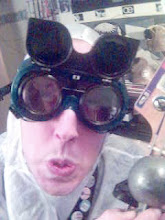
playing loud music. So I got a cheap boiler suit, some welding goggles and some
hazard tape and there was Cowman. A friend found a cow’s pelvis in a field that
we made into a kind of helmet that I wore for a while, but it was so
uncomfortable I gave it up. Recently I gave up on the goggles, as I was sick of
not being able to see at shows.
The name came from a few places, first I am a vegan, and
vegan shit can stink out a place, so when a flatmate said, ‘dude, you stink
like a cow, man’ the name stuck. I also like the Simpsons connection, ‘don’t
have a cow, man’ and the reference to a little known song by U.S. Maple “When a
man says ow.” As a vegan it is a reference to the fact that people are animals,
like saying a cow is like a man – you eat beef, but would you eat man beef?
Kind of confrontational. Most people don’t get it though.
Q: What’s with the music?
A: I like loud, distorted bass sounds, and so that it what I
have tried to create. I have recorded about 7 albums worth of material, with
the first effort ‘cowman’ now unavailable. That had a mixture of material where
I was experimenting with synths and different drum sounds, and some of it is
poor quality. The first proper album, ‘The Joy Of Not Being Sold Anything’ I am
still quite happy with. It came about as I was living in London and had been
working on material for a project I was working on with a friend called
Midnight Moth. That was about recording an album in 24 straight hours. We had
already recorded two fairly successful albums, however we got stuck with
‘artistic differences’ on the third, fell out big time (I haven’t spoken to him
since) and put all my creative juices into this Cowman album. In response to my
Midnight Moth partner selling cds with my playing on them without either my
consent or my feeling that the material was good enough to sell was to put
together an album to give away free. The golden inspiration was seeing the
fresh Banksy graffiti on a London billboard giving me the title and cover of
the album. Nice. Next was the pun titled ‘gina,’ get it? Cowmangina. Ha ha.
This is probably my favourite album as I managed to get a really high pitched,
electronic sounding bass/guitar sound that reminded me of Big Black. It is also
pretty dark too. After that was “Apocalypse Cow” (not the best pun I know)
which was a lot more experimental and disjointed – there is some synth stuff,
live drums, improvised stuff and some of my favourite songs like bubblegum bum
rape and senigalia on there, my first release on ingue records. The last album
was the crushingly intense “palpating the rumen” Around 70 minutes of
relentless high impact music. I was trying to create an album as tight as Big
Black’s “Songs About Fucking” and succeeded in making an album twice the
length. In hindsight I should have cut some of the material, but at the time I
wanted an evil beast, and that is what I ended up with, similar in some ways to
‘gina.’ That was in 2009, and since then I have recorded a covers album and an
experimental concept album (one track is on soundcloud), no release date for either yet, maybe 2013.
Q:Tour?
A:I find playing live a real headache, too many gadgets to
keep track of – this is the problem with being solo, however it is hugely
rewarding so I may be tempted into playing if I get the right offer. The problem
is the state of music in the UK at the moment is so deflated that a noise-rock
act like me is no longer a draw even as a novelty. With bands like Aids Wolf breaking up and Doomsday Student only playing the Supersonic Festival in
Birmingham and London it says to me that traditional touring routes are off,
only major cities need apply. Last time I played Bristol I was seen by about 10
people which gets a bit depressing, and if the promoter is losing money then so
are the bands. Live music is a decent income stream if you are in the right
band and you are promoted properly. Unfortunately being unsigned or ‘novelty’
does not get you good support slots or get you a good booking agent. But we’ll
see after I have finished my studies.
Q:Studies?
A: I’m currently working of a thesis about the writers PaulBowles and William S. Burroughs. When that is done I may have some more time
for music…

Sunday, April 15, 2012
A Nice Little Earner
UK dentists, in 2009, earned an average of £89,062 a year. Take home. Do they earn this? the last check up I had it took around 3 minutes for the dentist to look at my teeth, a service that cost me £16. I worked out the numbers, roughly against that amount (not taking into account expenses, but also more lucrative procedures such as implants, bridges, extractions etc.), it works out at about £2000 a day, which is 10,000 a week, a staggering £400,000 a year (working only 40 weeks). No wonder it is a profession attractive to business minded parents. But this is precisely the problem. It cannot be counted a 'caring' profession when it is so lucrative, as it inevitably attracts people who are interested in making money rather than making people well. A business minded person would not be considering what is in the interest of the patient, but rather what would earn the dentist the most money, hence the large number of unnecessary treatments, misdiagnoses and the array of additional services (such as the visit to the hygienist, usually costing £30 plus, which only recently has been added as a private service, in the past, and officially still, the dentist should perform at least a scale and polish, though now a patient has to demand this as dentists can save themselves time by not doing it, though ethically this means patients teeth care is worse). I have had numerous bad dentists over the years and am so sick of the service it makes me sick. People are right to be scared of dentists - as chances are they will have worse teeth and less money as a result of visiting one. I have had root filling done badly in 1992 causing an infection leading to an unpleasant hospital operation called an apisectomy. I still have an infection 20 YEARS LATER despite numerous check-ups (£16+ a time), an unnecessary extraction that cost £200 (another dentist would have charged £400 - both nhs) and a private root filling that cost £700, all to no avail. See why I place dentists up there with Estate Agents and Bank Managers. see here: BBC NEWS 2009
General Practitioners get my goat too. They're on at least £60,000 a year take home (why it's less than dentists I don't know, they seem to do loads more work). Okay, there are some good G.P.s out there, but increasingly their job is simply Google-ing your symptoms and then prescribing the appropriate drug (the brand on which depends on which company sponsors that particular doctor see here). G.P.s are also G.P.'s because they couldn't specialise at Uni - most med students, particularly the brightest and the best specialise in order to become surgeons or specialists in a field - so yes I am implying that G.P.s are the inferior med students. Hence the high numbers of misdiagnosed patients. It is again also the case, because of the law of interests, that it is never in a doctor or drug company's interest to cure a patient, as their income stream would instantly disappear. And new 'illnesses' like depression, ADHD etc. have essentially been constructed to sell more drugs and give G.P.s more work to do. Now I have suffered depression, and have had close friends suffer it too, and I have never seen a worse attempt at a cure than Prozac. And the UK government want to put these people on £300,000 a year, with more power over surgery spending? The drug companies must be rubbing their blood covered hands with glee. For more see here.
After seeing Schneidlomat's blog post about therapists in the US, I figured I should add my thoughts about said profession here. In my not extensive experience I have found 'councelors' (there is some confusion over what defines a councelor, therapist and psychotherapist - usually it is how long they spent in college) a somewhat strange breed. The question I ask myself is what makes someone become a councelor - and my cynical modern mind leads me to think in terms of 'it seems like an easy job - I'm a people person who likes talking to people - I can't think of anything else to do.' In common with dentists it is never in a councelor's interest to 'cure' the patient as this will cut off a source of revenue, what they need is to keep you interested in seeing them, as regularly as possible. It is also their job to listen to you and talk to you but it is not their job to either care or be your friend. This can often be a problem, as depression can stem from loneliness (more common than you'd think, especially in large cities - people who have lots of friends can feel very lonely too - some friendships can be very complex and unhelpful to mental health). Now I don't have an answer I just think it is worth thinking about some of these issues before seeking 'professional' help. I can also remember Psychology undergraduates who should never be councelors telling me that that was precisely the career path they saw for themselves. Again most people see Psychology as a 'soft' subject taken by undergrads who have no clear direction in life - not the best type of person to help you sort your life out. Perhaps it is better to try speaking to close friends or relations you already trust, or writing your feelings down. And cheaper.
Unfortunately most forward thinking countries have gone via the Health Insurance, total privatisation option, and while in the UK most would not wish to lose the NHS, it seems it has already gone. Just visited a Doctor in St Gallen. Fantastic service, wonderfully clean waiting and consulting rooms, waited 30 seconds before being seen by a really nice, friendly, relaxed doctor who put me at ease and got to the bottom of my problem very quickly, and as it was a common treatment could prescribe and supply medication in house. Medication was given to me at reception, the bill would be posted to my address! I love that. The trust that exists in sending bills to people that no longer exists in the UK. Returning to the hell that is UK dentistry you now have to pay for your check up or treatment BEFORE YOU HAVE HAD IT. This is insane - they have your address on record but still there is no trust, they want your cash or debit card payment UPFRONT, so if you are dissatisfied with the service - tough. Maybe it is because many people have tried to get away without paying but society cannot work like this. If I am going to buy a car I don't go to the garage, talk to the salesman and give him a load of money before I've even seen it or given it a test drive. I don't go to the supermarket ad give a load of money to the cashier and then collect my food (unless I buy online like a lazy, agoraphobic idiot). And if the dentist's don't trust me to pay for my treatment, why should I trust them to give me a good service - this thing works both ways. I'll miss St Gallen. When the UK does lose the NHS the private care provided will be like dentistry is already, upfront, overcharged poor service, and probably not far off the massive increases in charges made by water companies with no improvement in infrastructure or the private train system where ticket prices are a lottery and there is no guarantee you'll get anywhere. While the private systems in Switzerland are expensive, the work and work well. There is pride and trust in a system that works, and the taxes seem fair, along with wage levels being sufficient to pay for health insurance etc. Unfortunately in the UK wage levels are already insufficient to pay for NHS care, so a private system would in all likelihood be disastrous.
General Practitioners get my goat too. They're on at least £60,000 a year take home (why it's less than dentists I don't know, they seem to do loads more work). Okay, there are some good G.P.s out there, but increasingly their job is simply Google-ing your symptoms and then prescribing the appropriate drug (the brand on which depends on which company sponsors that particular doctor see here). G.P.s are also G.P.'s because they couldn't specialise at Uni - most med students, particularly the brightest and the best specialise in order to become surgeons or specialists in a field - so yes I am implying that G.P.s are the inferior med students. Hence the high numbers of misdiagnosed patients. It is again also the case, because of the law of interests, that it is never in a doctor or drug company's interest to cure a patient, as their income stream would instantly disappear. And new 'illnesses' like depression, ADHD etc. have essentially been constructed to sell more drugs and give G.P.s more work to do. Now I have suffered depression, and have had close friends suffer it too, and I have never seen a worse attempt at a cure than Prozac. And the UK government want to put these people on £300,000 a year, with more power over surgery spending? The drug companies must be rubbing their blood covered hands with glee. For more see here.
After seeing Schneidlomat's blog post about therapists in the US, I figured I should add my thoughts about said profession here. In my not extensive experience I have found 'councelors' (there is some confusion over what defines a councelor, therapist and psychotherapist - usually it is how long they spent in college) a somewhat strange breed. The question I ask myself is what makes someone become a councelor - and my cynical modern mind leads me to think in terms of 'it seems like an easy job - I'm a people person who likes talking to people - I can't think of anything else to do.' In common with dentists it is never in a councelor's interest to 'cure' the patient as this will cut off a source of revenue, what they need is to keep you interested in seeing them, as regularly as possible. It is also their job to listen to you and talk to you but it is not their job to either care or be your friend. This can often be a problem, as depression can stem from loneliness (more common than you'd think, especially in large cities - people who have lots of friends can feel very lonely too - some friendships can be very complex and unhelpful to mental health). Now I don't have an answer I just think it is worth thinking about some of these issues before seeking 'professional' help. I can also remember Psychology undergraduates who should never be councelors telling me that that was precisely the career path they saw for themselves. Again most people see Psychology as a 'soft' subject taken by undergrads who have no clear direction in life - not the best type of person to help you sort your life out. Perhaps it is better to try speaking to close friends or relations you already trust, or writing your feelings down. And cheaper.
Unfortunately most forward thinking countries have gone via the Health Insurance, total privatisation option, and while in the UK most would not wish to lose the NHS, it seems it has already gone. Just visited a Doctor in St Gallen. Fantastic service, wonderfully clean waiting and consulting rooms, waited 30 seconds before being seen by a really nice, friendly, relaxed doctor who put me at ease and got to the bottom of my problem very quickly, and as it was a common treatment could prescribe and supply medication in house. Medication was given to me at reception, the bill would be posted to my address! I love that. The trust that exists in sending bills to people that no longer exists in the UK. Returning to the hell that is UK dentistry you now have to pay for your check up or treatment BEFORE YOU HAVE HAD IT. This is insane - they have your address on record but still there is no trust, they want your cash or debit card payment UPFRONT, so if you are dissatisfied with the service - tough. Maybe it is because many people have tried to get away without paying but society cannot work like this. If I am going to buy a car I don't go to the garage, talk to the salesman and give him a load of money before I've even seen it or given it a test drive. I don't go to the supermarket ad give a load of money to the cashier and then collect my food (unless I buy online like a lazy, agoraphobic idiot). And if the dentist's don't trust me to pay for my treatment, why should I trust them to give me a good service - this thing works both ways. I'll miss St Gallen. When the UK does lose the NHS the private care provided will be like dentistry is already, upfront, overcharged poor service, and probably not far off the massive increases in charges made by water companies with no improvement in infrastructure or the private train system where ticket prices are a lottery and there is no guarantee you'll get anywhere. While the private systems in Switzerland are expensive, the work and work well. There is pride and trust in a system that works, and the taxes seem fair, along with wage levels being sufficient to pay for health insurance etc. Unfortunately in the UK wage levels are already insufficient to pay for NHS care, so a private system would in all likelihood be disastrous.
Subscribe to:
Posts (Atom)